Is SEO still relevant for generative AI search?
Absolutely yes. Search engine optimisation (SEO) is considering what your website needs to be recommended by Google. Generative engine optimisation (GEO) is considering what your website and your entire digital online presence is, to be recommended and cited by AI search engines. From our perspective, digital visibility online now means factoring it all in. SEO and GEO are equally important.
Why should you consider SEO and GEO?
We know SEO is important. Why should we consider both? Because people are changing the way they search with AI. Query fan-outs are, in my words, the key to this change. So what is a query fan-out? It is when the AI model creates many related searches at the same time, searching these similar queries to find the best answer to the question the person has typed into search. AI search pulls information from across the internet to find this most accurate and correct answer, so it is important to consider how your business shows up across the internet. As platforms such as YouTube, LinkedIn, Facebook, review site and Reddit, are some of the sources of information for the AI search engine.
Google as the ‘great overseer…’
Google is the foundation and the rule setter for digital search and visibility. As we discussed in our last blog post on Google's latest spam policies, it is important to be aware of Google's determined best practices. We think it is easier than ever for them now, with AI, to monitor and regulate their policies across the internet. Your ranking can be impacted, if you were to practice spammy policies or bulk produce content that isn’t helpful for the reader, to name a couple.
We are optimising online for an algorithm that is changing the rules faster than ever, AI can regulate and implement these new changes. Some things remain the same, however, and this also applies in life, I believe. Google, AI and humans are asking for originality in a world of fast answers.
“Creating content that people find unique, compelling, and useful will likely influence your website’s presence in generative AI search in the long run.”
Read in depth how to optimise for AI search according to Google’s own guidelines here
We Say: Don’t compromise who you are, to optimise for search
This is why we write our own content. I don't know if my writing is "better" than AI's. AI can probably get the point across in a more to-the-point way (often frustratingly so!). But I still won't get it to write for me. I want my own words posted out into the landscape online, a human voice to contribute to the noise of AI's words. I think this becomes more important every day.
Our advice at Luminera is not to compromise on who you are to optimise for search. Because that's the piece that makes what you wrote, or what you offer, stand out. We see that it is this applied consistently over time, that gets results. Your originality is what contributes to your business being recommended, cited and found by those who are looking for you online. Which makes so much sense as ultimately, at the point of sale, the customer is looking at you, at your website. Naturally, by enjoying what you do, while keeping in mind some simple guidelines, you can be consistent, be yourself resulting in a flow on effect of being more visible online.
The Guidelines: What to consider when writing your website for SEO and GEO to get found online.
Googles automated systems are designed to identify relevant content when someone searches for what you offer, so that Google knows it is recommending trustworthy, content. This is why E-E-A-T is important when considering your digital marketing approach, creating helpful, reliable people-first content, as Google has a reputation to uphold.
Experience. Expertise. Authoritativeness. Trustworthiness.
Reference where you got your information from where relevant.
AI tools read your website and profiles to get facts, so keep them up to date.
Write in your query fan-outs.
Create valuable non-commodity content for your audience.
Write in a way that is easy for your human audience to read, consider your structure and your headings to make it easy for humans to navigate content.
Use high quality images and video
Meeting Search Technical Requirements
It does not cost you anything to be found in Google. Your page needs to meet three basic technical checks. Google's crawler (the bot that reads your website, called Googlebot) must not be blocked. Your page must load properly, which Google sees as a "200" success code. And your page must have content that Google is able to read and add to its index. Meeting these checks makes your page eligible to show in search results, but it does not guarantee a spot. This is where we come in at Luminera. We check your website behind the scenes to make sure nothing is blocking Google, that your pages are working, and that your content can be found. We use Google Search Console, a free tool from Google, to confirm that your pages are indexed, and we fix any problems we find. That way you know your website is actually showing up, and you can focus on running your business.
How to get your relevant keywords and query fan-outs for free.
A simple step-by-step process to find out what keywords are relevant to what people are searching when they think of your business.
1. Put yourself in the shoes of your ideal customer. Who are they? What do they want?
2. Knowing who your customer is, what do you think they will be searching online when they are wanting your services?
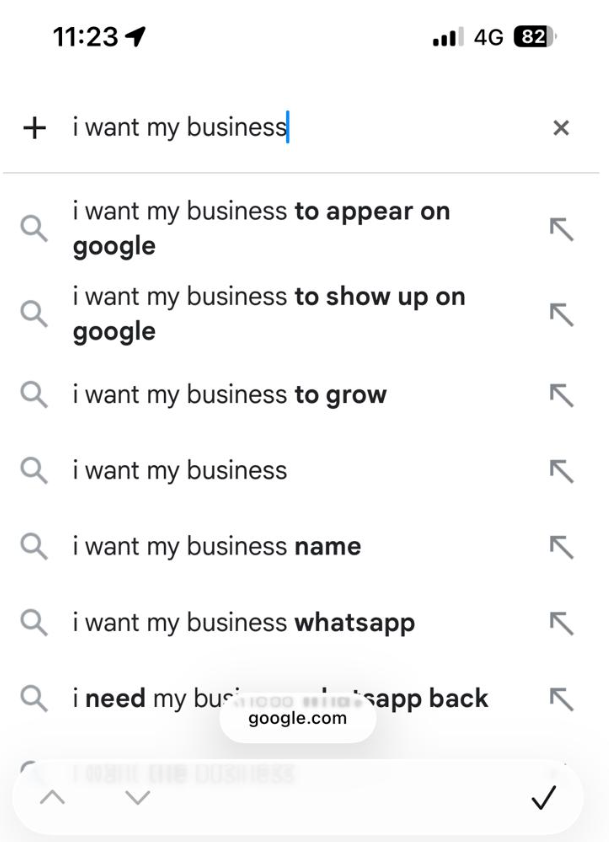
3. Open an incognito browser. Then open up Google Search.
4. Start typing with one keyword. Google will automatically give you several options. This is Google's autocomplete, and it will show you what people are actually searching for a lot. These are not guesses; they are suggested because many people have been typing these searches. They do however change depending on your location, trends and own past searches, which is why opening it in an incognito window is important to help get less biased results.
5. Once you have your keywords, write some content around these words. Use these words naturally, in your own sentances. For example, in this case we got "to appear on Google." This could be adding in a frequently asked question about it, or text on your About Us page. This is helpful for SEO.
6. Generative Engine Optimisation
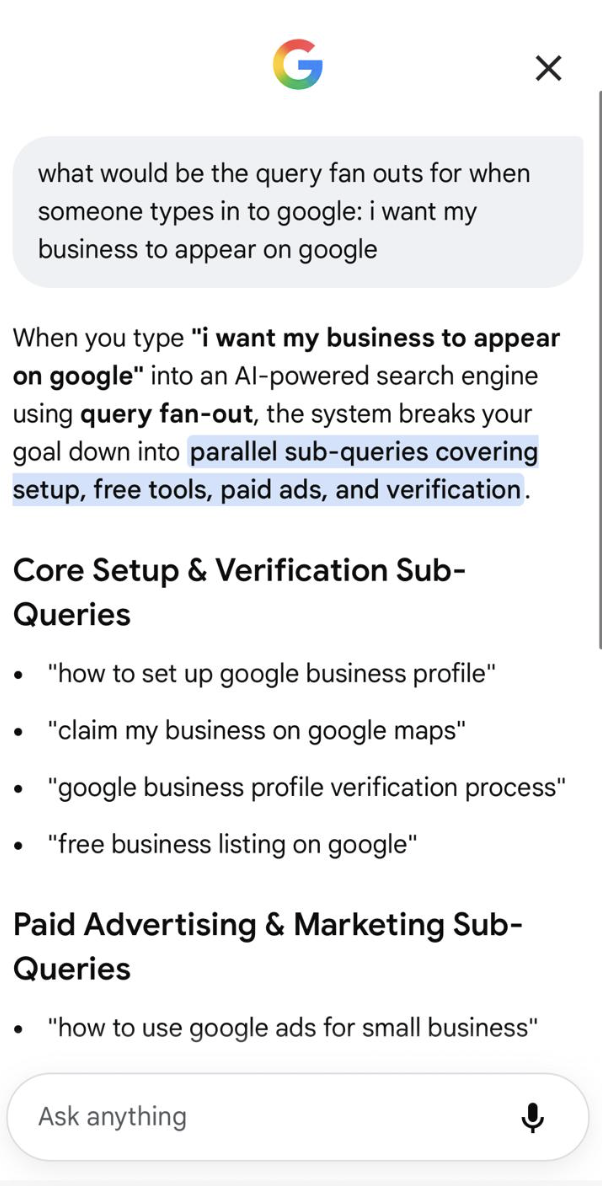
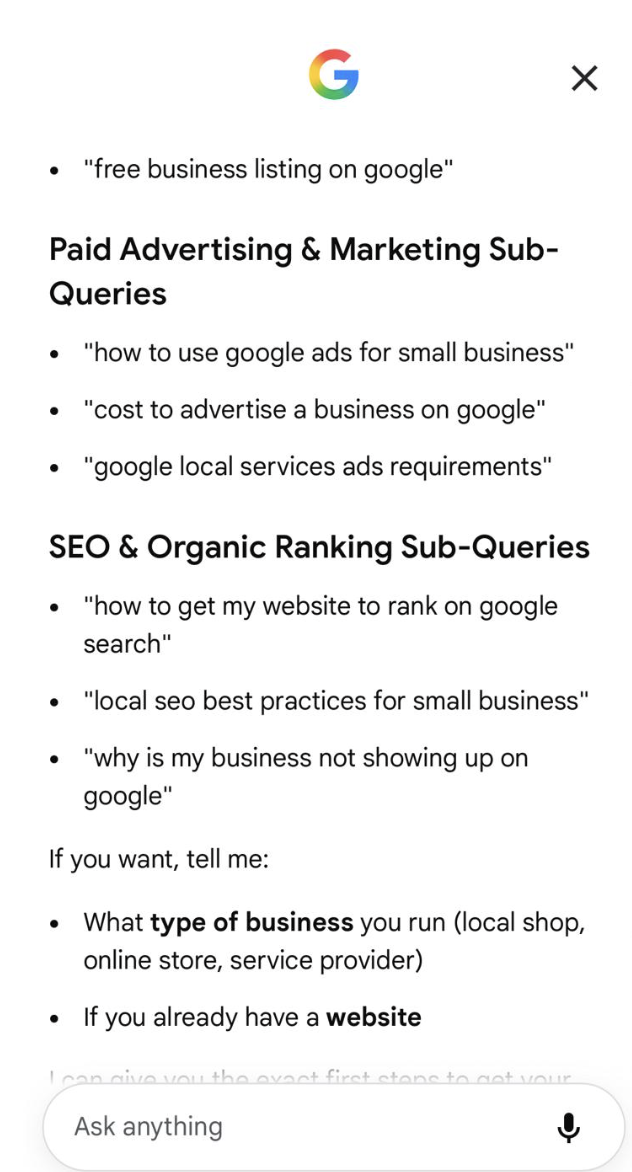
Tailor it to GEO by factoring in the way that an AI search engine bot works. They work by considering all the different ways someone could type to get a similar answer. This is called query fan-out. You can type this into Google: "What would be the query fan-outs for when someone types into Google: I want my business to appear on Google?" Use this list to find the real questions your customers ask. Then answer them in your own words. You could write a blog about it, or an FAQ to answer these questions.
Note: that this is Google guessing what the fan-outs would be it does not show the real searches that Googles AI runs, however it does give you a great foundation to work from.
Let us know in the comments below if you tried this process, and if you were surprised with what Google came back with!
Want a more in depth look at how visible your website is to AI Search engines?